IQ-Bookmaker automates the work of a betting shop end to end: it keeps track of sporting and other events across different sports, accepts bets on those events and lets you build your own lines. The interface is designed for a cashier working at speed — placing a bet takes a handful of actions.
The product is built on a client/server architecture over an Oracle database and consists of three main applications.
What the system is made of
Cash desk
The betting shop cash module: taking bets, paying out winnings, working with customer cards, finding a bet by card number and reviewing outcomes. The cashier sees only what the operation requires and cannot alter the line.
Line editor
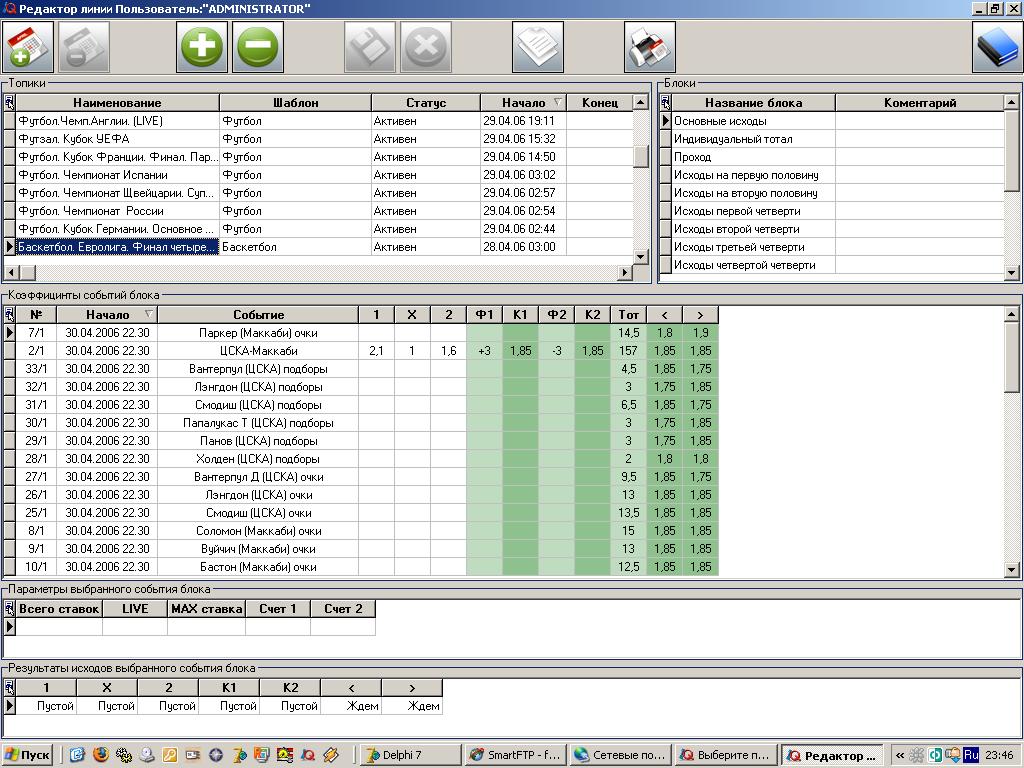
The core module of the system. This is where the line is built: topics by sport, outcome blocks (main outcomes, totals, handicaps, outcomes by half and by quarter) and the odds for every event. Bets are accepted and settled from here too, and the analytical applications for financial analysis of the business live in the same module.
Reports
A report builder for documents of any complexity, based on prepared templates. You can assemble your own templates without involving the developer — which matters when the regulator or the owner changes what has to be reported.
Remote betting points
The system connects remote betting points over the internet. The server sits in the bookmaker’s office, while cash desks and bookmakers’ workstations in the betting points connect to it over a secure channel — through a DSL modem on the point’s local network, or through a separate agent on a telephone line.
Architecture and data protection
Client-server
All database work happens on the server and does not depend on failures at the workstations. Data is stored on the server only; workstations merely display information. A machine on the floor being switched off or swapped out does not cost you bets.
Biometric identification
Users log in with a fingerprint. Biometrics remove the passwords and keys that staff pass to one another, and tie every operation unambiguously to a particular employee.
AES-256 encryption
Data in the server tables is stored encrypted with AES-256 (Advanced Encryption Standard). The encryption is permanent, not merely applied to backups: the contents of the database stay closed even on ordinary server hardware and even with direct access to the files.
| Architecture | client/server |
|---|---|
| Database | Oracle |
| Modules | Cash desk · Line editor · Reports |
| Remote points | over the internet, DSL or a telephone line |
| Identification | fingerprint |
| Encryption | AES-256, permanent |